Understanding Mattress Layers: What's Really Inside Your Bed
Every mattress is made of multiple layers, each with a specific job. Learn how comfort layers, transition zones, and support cores work together—and which materials deliver the best sleep.
David Patel
Technical Editor • Former Product Reviewer, Which?
Updated: 22 January 2026
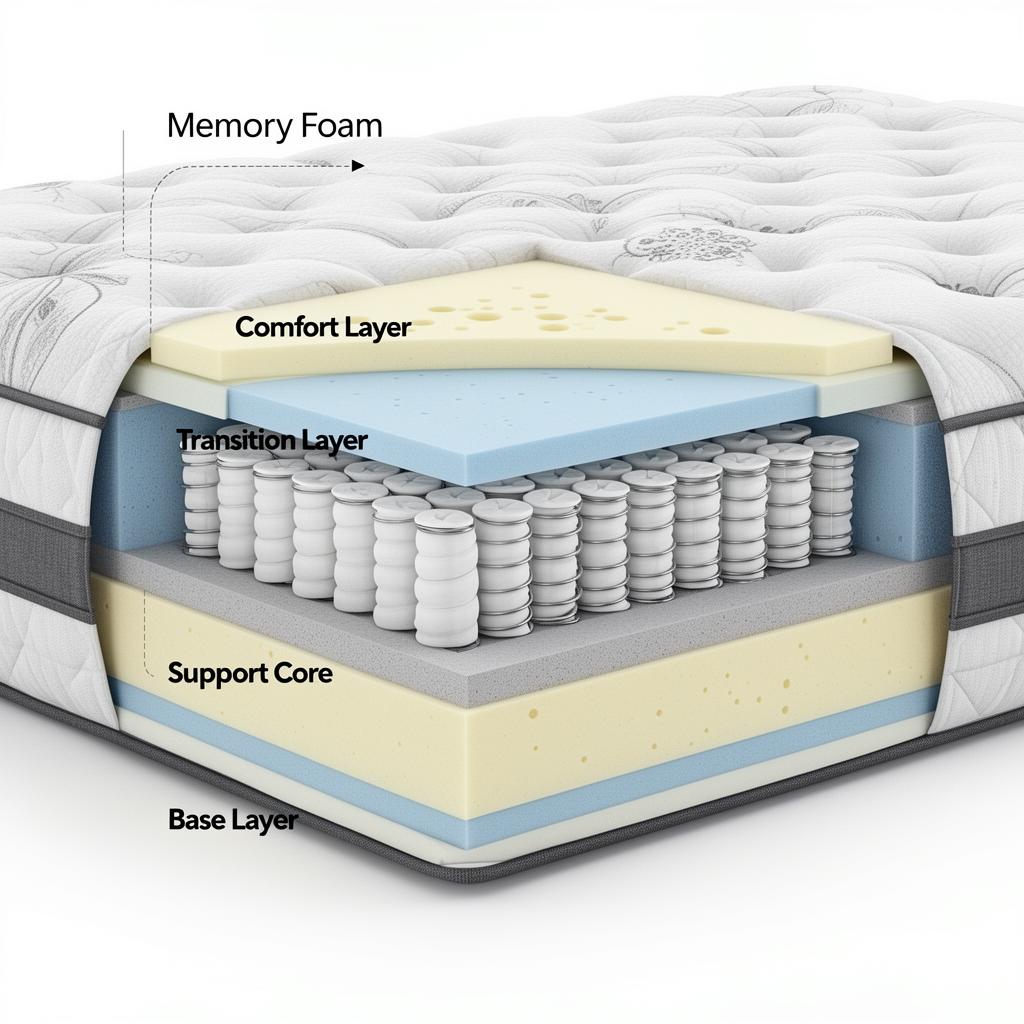
Anatomy of a modern mattress: comfort layer, transition layer, pocket spring support core, and base layer
Walk into any mattress showroom and you'll be bombarded with marketing jargon: "7-zone support", "graphite-infused memory foam", "2000 pocket springs". But what does any of this actually mean for your sleep?
Understanding mattress layers is the key to cutting through the noise. Once you know how each layer functions—and which materials perform best—you can evaluate any mattress like an expert. This guide breaks down mattress anatomy layer by layer, with specific recommendations for UK buyers.
Whether you're shopping for your first adult mattress or replacing one after 10 years, this knowledge will save you money and prevent buyer's remorse. Let's look inside the mattress.
The 4 Layers of a Modern Mattress
Most quality mattresses have four distinct layers, each performing a specific function. Here's what each layer does and why it matters.
Comfort Layer (Top)
Pressure relief, initial cushioning, temperature regulation
Transition Layer (Middle)
Gradual support transition, prevents bottoming out
Support Core (Base)
Spinal alignment, deep compression support, durability
Base Layer (Foundation)
Foundation, edge support, breathability
Comfort Layer: Where You Feel the Mattress
The comfort layer is the topmost section—typically 2-10cm thick—that your body sinks into. It's responsible for pressure relief at shoulders, hips, and other contact points. This layer determines whether the mattress feels soft, medium, or firm on initial contact.
Key considerations:
- Side sleepers need thicker, softer comfort layers
- Memory foam excels at pressure relief but can sleep hot
- Latex offers pressure relief with better breathability
Support Core: The Foundation of Spinal Alignment
The support core—usually 12-20cm thick—is the structural heart of your mattress. It maintains spinal alignment by preventing your heavier body parts (hips, shoulders) from sinking too deep. Without a quality support core, no amount of comfort layer padding will give you good sleep.
Key considerations:
- Pocket springs offer excellent support and airflow
- High-density foam cores suit motion isolation needs
- Heavier sleepers need firmer, more robust cores
Transition Layer: The Unsung Hero
The transition layer sits between comfort and support, typically 2-5cm thick. It creates a gradual feel change from soft to firm and prevents "bottoming out"—that jarring feeling when you sink through the comfort layer and hit the hard support core.
Why it matters:
- Essential for softer mattresses with thick comfort layers
- Helps heavier sleepers who compress comfort layers more
- Often made from firmer foam or micro pocket springs
Base Layer: Stability and Longevity
The base layer (1-3cm) provides the foundation for everything above. It prevents sagging, improves edge support, and often includes reinforced materials along the perimeter. A good base layer extends mattress lifespan significantly.
Features to look for:
- Reinforced foam around edges prevents "roll-off"
- Non-slip bottom keeps mattress in place
- Ventilation channels improve airflow from below
Comfort Layer Materials Compared
The comfort layer material determines pressure relief, temperature regulation, and initial feel. Here's how the main options stack up.
| Material | Pressure Relief | Cooling | Responsiveness | Durability | Best For |
|---|---|---|---|---|---|
| Memory Foam | Excellent | Poor-Average | Slow | Good (8-10 years) | Side sleepers, pressure point pain, motion isolation |
| Latex (Natural) | Very Good | Excellent | Fast | Excellent (15+ years) | Hot sleepers, eco-conscious buyers, combination sleepers |
| Latex (Synthetic) | Good | Good | Fast | Good (8-10 years) | Budget buyers wanting latex feel |
| Gel-Infused Foam | Excellent | Good | Slow-Medium | Good (8-10 years) | Hot sleepers who want memory foam feel |
| Polyfoam | Average | Average | Medium | Fair (5-7 years) | Budget mattresses, transition layers |
| Pillow-Top Fibres | Good | Excellent | Fast | Fair (5-8 years) | Traditional feel, breathability |
Best for Side Sleepers
Memory foam or gel-infused foam—excellent at relieving shoulder and hip pressure.
Best for Hot Sleepers
Natural latex or pillow-top fibres—exceptional breathability and temperature regulation.
Best for Combination Sleepers
Latex or responsive polyfoam—fast response makes position changes easier.
Support Core Types: Springs vs Foam
The support core determines spinal alignment, durability, and motion isolation. Here are the main types available in UK mattresses.
| Core Type | Spring Count | Support | Motion Isolation | Edge Support | Best For |
|---|---|---|---|---|---|
| Pocket Springs | 800-3000+ | Excellent | Very Good | Excellent | Couples, heavier sleepers, those wanting traditional support |
| Bonnell/Open Coil | 300-400 | Good | Poor | Average | Budget buyers, guest rooms |
| Continuous Coil | 600-900 | Good | Average | Good | Mid-range buyers, durability focus |
| High-Density Foam | N/A | Very Good | Excellent | Average | Motion isolation priority, all-foam preference |
| Latex Core | N/A | Excellent | Good | Good | Natural materials, responsive support, durability |
Understanding Pocket Spring Counts
UK retailers often market mattresses by spring count—1000, 2000, even 6000 springs. But more isn't always better. Here's what actually matters:
Spring Gauge
Wire thickness (measured in mm). Lower gauge = thicker wire = firmer support. Look for 1.2-1.5mm for durability.
Spring Height
Taller springs (12-15cm) provide more responsive support than shorter mini-springs (5-8cm).
Sweet Spot
For most adults, 1000-2000 quality springs is sufficient. Above 3000 often uses smaller, thinner springs.
Foam Density: The Hidden Quality Indicator
Foam density (measured in kg/m³) is the single best predictor of mattress durability. Higher density = longer lifespan. Here's how to interpret the numbers.
| Density Range | Quality Level | Expected Durability | Best Use | Notes |
|---|---|---|---|---|
| Low (under 30kg/m³) | Budget | 3-5 years | Guest beds, short-term | Avoid for primary mattress |
| Medium (30-45kg/m³) | Standard | 5-7 years | Transition layers, budget comfort layers | Acceptable for budget mattresses |
| High (45-60kg/m³) | Good | 8-10 years | Quality comfort layers, support cores | Recommended minimum for comfort layers |
| Very High (60kg/m³+) | Premium | 10+ years | Premium mattresses, heavy users | Best for durability and support |
Why Density Matters
Most budget mattresses use foam under 40kg/m³ density. These foams break down quickly, developing body impressions and losing support within 3-5 years. Spending £100-200 more on a mattress with 50kg/m³+ foam often saves money long-term because the mattress lasts twice as long. Always ask retailers about foam density—if they won't tell you, that's a red flag.
How Different Mattress Types Are Constructed
Each mattress type uses layers differently. Understanding these configurations helps you match construction to your needs.
All-Foam Mattresses
Layer Structure:
Comfort foam → Transition foam → Support foam → Base foam
Advantages
- Excellent motion isolation
- Good pressure relief
- Quiet
- Affordable
Disadvantages
- Can sleep hot
- Less edge support
- Less responsive
Hybrid Mattresses
Layer Structure:
Comfort foam → Transition layer → Pocket springs → Base
Advantages
- Best of both worlds
- Good airflow
- Strong edge support
- Responsive
Disadvantages
- Heavier
- More expensive
- Can be noisy
Pocket Spring Mattresses
Layer Structure:
Comfort fibres/foam → Pocket springs → Base
Advantages
- Excellent support
- Great airflow
- Traditional feel
- Durable
Disadvantages
- Less pressure relief
- More motion transfer
- Can be firm
Latex Mattresses
Layer Structure:
Soft latex → Medium latex → Firm latex core
Advantages
- Very durable
- Natural option
- Responsive
- Cool sleeping
Disadvantages
- Expensive
- Heavy
- Different feel
Pillow-Top Mattresses
Layer Structure:
Pillow-top → Springs → Base (topper sewn to cover)
Advantages
- Plush feel
- Good breathability
- Traditional luxury
Disadvantages
- Cannot flip
- Topper can wear unevenly
- Hard to clean
Frequently Asked Questions About Mattress Layers
Expert answers to the most common questions about mattress construction.
Summary: What to Look for in Mattress Layers
Understanding mattress layers transforms you from a confused shopper into an informed buyer. Here's a quick recap of what matters most:
Layer Checklist
- Comfort layer: At least 3cm of quality foam/latex
- Transition layer: Essential for softer mattresses
- Support core: 12cm+ springs or high-density foam
- Edge support: Reinforced perimeter for durability
Red Flags to Avoid
- Foam density under 40kg/m³ (budget mattresses)
- No transition layer in soft mattresses
- Very high spring counts with thin gauge wire
- Retailers who won't disclose material specifications
Armed with this knowledge, you can evaluate any UK mattress—whether shopping online with Emma or Simba, or visiting a Dreams or John Lewis showroom. Ask about foam density, spring gauge, and layer thickness. If a retailer can't answer these questions, consider shopping elsewhere.
About the Author
David Patel
Technical Editor • Former Product Reviewer, Which?
David spent 7 years at Which? developing and running their mattress testing programme. He designed our scoring methodology and ensures every review meets the highest standards of objectivity. His deep understanding of mattress construction helps UK consumers cut through marketing jargon and identify truly quality products.