Hybrid vs Memory Foam Mattress: Which Is Right for You?
Two of the most popular mattress types in the UK, but they're fundamentally different. This expert comparison helps you choose based on your sleep style, body type, and priorities.
James Wright
Lead Product Tester • Former Quality Manager, Silentnight Beds
Updated: 22 January 2026
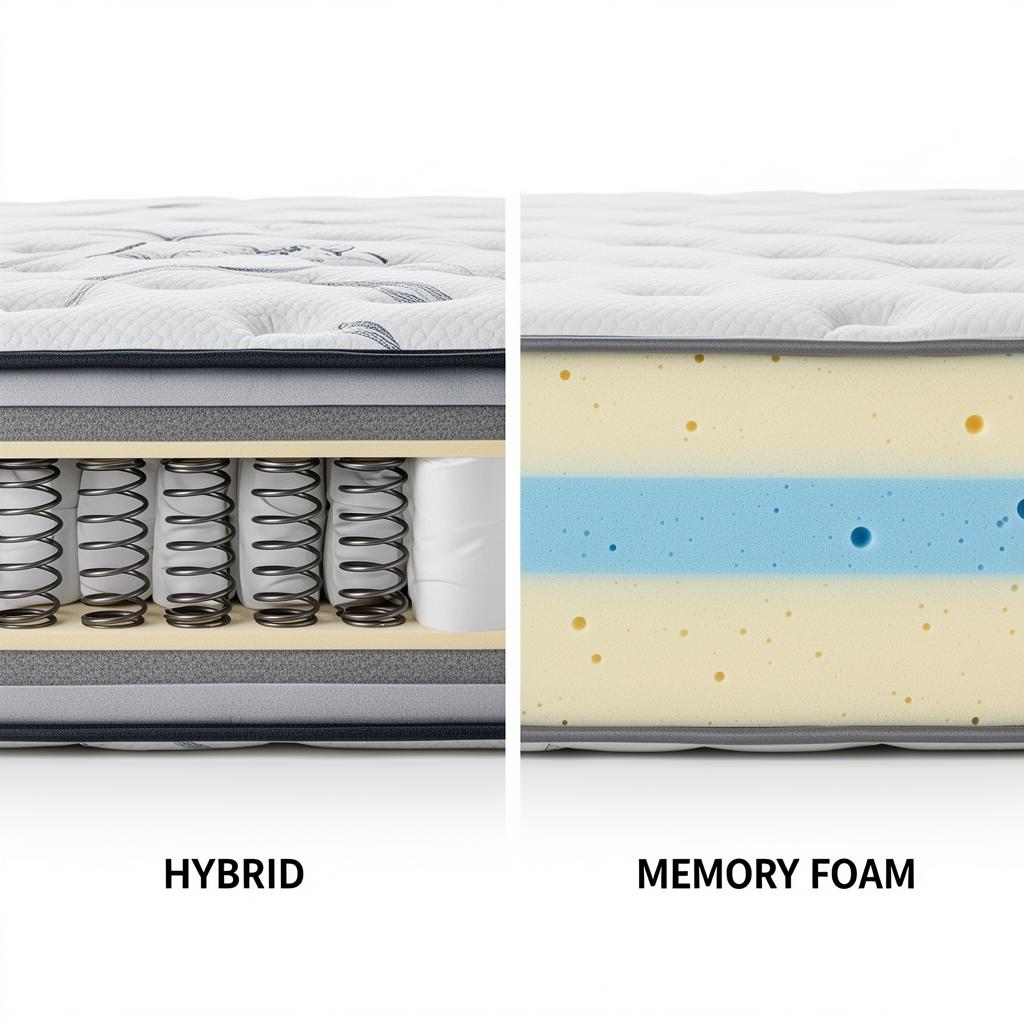
Hybrid mattresses feature pocket springs for support (left), while memory foam uses multiple foam layers (right)
Quick Answer: Which Should You Choose?
Choose Memory Foam If:
- • You're primarily a side sleeper
- • You want maximum pressure relief
- • Motion isolation is your top priority
- • You're on a tighter budget (under £500)
- • You like the "hugging" sensation
Choose Hybrid If:
- • You sleep hot or live in a warm home
- • You change positions during the night
- • Edge support matters (couples, small rooms)
- • You want a responsive, bouncy feel
- • You're a back or stomach sleeper
"Should I get a hybrid or memory foam mattress?" is one of the most common questions we receive. Both types dominate the UK mattress market, and both can deliver excellent sleep—but they do so in fundamentally different ways.
Memory foam mattresses are constructed entirely from foam layers. They conform closely to your body, providing excellent pressure relief and motion isolation. They're often more affordable but can sleep hot and feel slow to respond.
Hybrid mattresses combine foam comfort layers with a pocket spring support core. They offer the best of both worlds: foam's pressure relief with springs' support, breathability, and responsiveness. They're typically more expensive but more versatile.
This guide compares every aspect that matters—from pressure relief to temperature, support to durability—so you can make the right choice for your body, sleep style, and budget.
Hybrid vs Memory Foam: Head-to-Head Comparison
A quick reference comparing the key characteristics of each mattress type.
| Feature | Memory Foam | Hybrid |
|---|---|---|
| Construction | Multiple foam layers only | Foam layers + pocket spring core |
| Pressure Relief | Excellent | Very Good |
| Support | Good | Excellent |
| Motion Isolation | Excellent | Very Good |
| Edge Support | Average | Excellent |
| Temperature | Warm (can sleep hot) | Cooler (springs allow airflow) |
| Responsiveness | Slow (sinking feeling) | Fast (bouncy feel) |
| Durability | 8-10 years | 8-12 years |
| Weight | Light-Medium | Heavy |
| Price Range (UK) | £300-£900 | £500-£1,500 |
| Best For | Side sleepers, pressure relief | All positions, couples, hot sleepers |
Detailed Feature Analysis
A deeper look at how each mattress type performs across the factors that matter most for sleep quality.
Pressure Relief
Memory Foam
Memory foam excels at pressure relief. It moulds precisely to your body shape, distributing weight evenly and eliminating pressure points at shoulders and hips. This is why it's often recommended for side sleepers and those with joint pain.
Hybrid
Hybrids offer very good pressure relief through their foam comfort layers, though slightly less conforming than pure memory foam. The spring layer provides more pushback, which some find more comfortable for pressure relief.
Temperature Regulation
Memory Foam
Traditional memory foam's biggest weakness. It conforms closely, trapping body heat. Gel-infused and open-cell versions improve cooling, but memory foam still sleeps warmer than alternatives. A significant issue for hot sleepers.
Hybrid
The pocket spring core allows air to circulate through the mattress, dissipating heat effectively. Combined with thinner foam layers on top, hybrids sleep significantly cooler than all-foam mattresses.
Motion Isolation
Memory Foam
Memory foam absorbs movement exceptionally well. When one partner moves or gets up, the other barely feels it. Ideal for couples with different sleep schedules or restless sleepers.
Hybrid
Pocket springs are individually wrapped, so they move independently. This provides very good motion isolation—not quite as good as memory foam, but excellent for most couples.
Edge Support
Memory Foam
All-foam mattresses typically have weak edges. Sitting on the edge causes significant sinking, and sleeping near the edge can feel unsecure. Some brands add reinforced foam edges, but it's rarely as sturdy as springs.
Hybrid
The spring core provides excellent edge support. You can sit on the edge without sinking excessively, and the full sleeping surface is usable. Essential for couples who need every inch of space.
Responsiveness
Memory Foam
Memory foam responds slowly to pressure, creating the classic "sinking in" sensation. This can make changing positions feel effortful, and some sleepers describe feeling "stuck". Less suitable for combination sleepers.
Hybrid
Springs provide immediate pushback, making position changes effortless. The mattress responds quickly to movement. Much better for combination sleepers who change positions throughout the night.
Support & Spinal Alignment
Memory Foam
Good support when foam density is high enough (50kg/m³+). However, memory foam can allow heavier body parts to sink too deep if the support layer isn't robust, potentially compromising spinal alignment.
Hybrid
Pocket springs excel at support. They respond proportionally to weight—sinking more under heavier areas (hips) and less under lighter areas (waist), maintaining neutral spinal alignment in all positions.
Best Mattress Type by Sleeper Profile
Your sleep position, body type, and specific needs determine which mattress type will work best for you.
Side Sleepers
Side sleepers need excellent pressure relief at shoulders and hips. Memory foam's conforming properties excel here. If you sleep hot, choose a hybrid with a thick memory foam comfort layer.
Back Sleepers
Back sleepers need support under the lumbar curve. Hybrids provide the firm support base needed for spinal alignment, with enough comfort layer for pressure relief.
Stomach Sleepers
Stomach sleepers need a firm surface to prevent the pelvis sinking and hyperextending the spine. Memory foam is generally too soft; a firm hybrid is ideal.
Combination Sleepers
If you change positions during the night, hybrid mattresses' responsiveness makes repositioning effortless. Memory foam's slow response can make position changes feel laborious.
Hot Sleepers
Memory foam traps body heat. Even gel-infused versions sleep warmer than hybrids. The spring core in hybrids allows air circulation that keeps the sleep surface cooler.
Couples
Hybrids offer the best combination of motion isolation (for undisturbed sleep) and edge support (maximising usable space). Memory foam has better motion isolation but poor edges.
Heavier Individuals (14+ stone)
Heavier sleepers compress foam more, potentially sinking through comfort layers. The spring core in hybrids provides robust, lasting support that doesn't break down as quickly.
Budget Buyers
Quality memory foam mattresses start around £300-400 for a double. Hybrids typically cost £500+ due to the more complex construction. For tight budgets, memory foam offers better value.
Top UK Brands Compared
The leading memory foam and hybrid mattresses available in the UK market, with prices, trial periods, and ratings.
Memory Foam Mattresses
Emma Original
Best overall memory foam
Nectar Memory Foam
Best trial period
Eve Original
Good value option
Tempur Original
Premium memory foam
Hybrid Mattresses
Simba Hybrid
Best overall hybrid
Emma Hybrid
Great all-rounder
Brook + Wilde Elite
Firmness choice
OTTY Hybrid
Value hybrid
Pros and Cons Summary
Memory Foam
Advantages
- Excellent pressure relief—ideal for side sleepers and joint pain
- Superior motion isolation—perfect for couples with different schedules
- Typically more affordable than comparable hybrids
- Quiet—no springs means no noise
- Lighter weight—easier to rotate and move
- Great for allergies—fewer places for dust mites
Disadvantages
- Sleeps hot—body heat gets trapped in foam
- Slow responsiveness—can feel "stuck" when changing positions
- Weak edge support—sitting on the edge causes sinking
- Initial off-gassing smell (usually fades within days)
- Can feel too soft for stomach sleepers and heavier individuals
- Less durable than high-quality pocket springs
Hybrid
Advantages
- Best of both worlds—foam comfort with spring support
- Sleeps cooler—air circulates through spring layer
- Excellent edge support—full surface is usable
- Responsive—easy to change positions during sleep
- Works for all sleep positions and body types
- Strong durability—quality springs last 10+ years
Disadvantages
- More expensive than equivalent memory foam mattresses
- Heavier—harder to rotate and can be delivery issues
- Some noise possible from springs (rare with pocket springs)
- Slightly less motion isolation than pure memory foam
- More complex construction means more potential failure points
- Harder to find budget options under £500
Frequently Asked Questions
Expert answers to the most common hybrid vs memory foam questions.
The Verdict: Which Should You Buy?
After testing dozens of both mattress types, our recommendation is clear: for most UK sleepers, a hybrid mattress offers better overall value. The combination of foam comfort with spring support, cooling, and edge support makes hybrids more versatile and longer-lasting.
Choose Memory Foam If:
- You're a dedicated side sleeper needing maximum pressure relief
- Budget is under £500 for a double mattress
- Motion isolation is your absolute top priority
- You love the slow, conforming "hug" sensation
Choose Hybrid If:
- You sleep in multiple positions or run hot
- You share the bed and need edge support
- You want a responsive, easy-to-reposition surface
- Long-term durability is important to you
Both mattress types can deliver excellent sleep when chosen correctly. The most important thing is matching the mattress to your specific needs—and taking advantage of trial periods to test your choice at home.
About the Author
James Wright
Lead Product Tester • Former Quality Manager, Silentnight Beds
James spent 10 years in quality control at Silentnight, the UK's largest bed manufacturer. His insider knowledge of mattress construction and materials helps us evaluate what truly makes a mattress last—and what leads to premature sagging. His hands-on experience with mattress manufacturing gives unique insight into which construction methods truly deliver lasting comfort.